Technology
05 minutes

From reporting tool to strategic infrastructure

As the insurance industry enters a more data-driven era, insights from BarnOwl show why data is no longer just about reporting, but about trust, compliance and strategic decision-making. This article explores how brokers must evolve from data collectors to data stewards.
Written by
COVER
Published on
January 23, 2026

If the insurance industry spent much of the last decade talking about data, 2025 was the year it finally started wrestling with it.

Across my conversations with BarnOwl Data Solutions, one message came through clearly: Data is no longer about dashboards, hindsight reporting, or regulatory box-ticking. It is becoming the operational backbone of how insurers, brokers, and regulators expect insurance businesses to function.

As we head into 2026, the shift underway is not simply technological. It is philosophical. The industry is moving from asking “what data do we have?” to “what decisions does our data allow us to make?”

From volume to validity - One of the strongest trends emerging from the BarnOwl discussions was the growing recognition that more data does not automatically mean better insight.

Insurance businesses are drowning in information, policy records, endorsements, claims, client communications, compliance documents, yet still struggle to answer basic questions with confidence. What is the real exposure in the book? Where are the conduct risks? Which clients are underserved, over-insured, or at risk of churn?

The issue, as BarnOwl consistently highlighted, is data quality and structure. Poorly categorised, inconsistently captured, or manually manipulated data creates false confidence. By 2026, insurers and regulators alike will expect decision-grade data, data that can be trusted without lengthy reconciliation.

For brokers, the lesson is uncomfortable but necessary: clean data is now a professional obligation, not an admin nice-to-have.

Compliance is becoming data-led - Perhaps the most significant shift heading into 2026 is how compliance is evolving.

Historically, compliance in insurance has been retrospective and document driven. Files were assembled, reports compiled, and evidence produced when asked. That model is no longer sufficient.

Regulators are increasingly focused on patterns of behaviour, not isolated breaches. This requires data that can demonstrate consistency, suitability, and fairness across an entire book of business.

BarnOwl’s work sits squarely in this transition. The ability to analyse adviser behaviour, product concentration, replacement trends, fee structures, and advice outcomes across time is becoming central to how insurers and FSPs demonstrate conduct compliance.

The implication for brokers is clear: If your data cannot tell your compliance story, someone else will.

The broker as data steward - One of the more subtle but powerful insights from the BarnOwl discussions was the shifting role of the broker in the data ecosystem.

Traditionally, brokers were data collectors, passing information upstream to insurers and administrators. That dynamic is changing. Brokers are now increasingly seen as data stewards, responsible for the integrity of client information across its entire lifecycle.

This matters because data errors at broker level cascade through underwriting, claims, compliance reporting, and client communication. In 2026, insurers will place growing emphasis on working with intermediaries whose data is structured, reliable, and usable.

For brokers, this presents both a risk and an opportunity. Those who invest in data discipline, consistent capture, proper categorisation, and integrated systems will be easier to trade with, easier to audit, and more valuable as partners.

“Data is becoming the infrastructure of trust in insurance.”

COVER

Those who don’t will increasingly find themselves excluded from preferred panels, advanced tools, and insurer support.

Moving from hindsight to foresight - Another defining theme was the move away from backward-looking reporting toward predictive and preventative insight.

BarnOwl’s analytics approach reinforces the idea that data should not merely explain what happened last quarter, but help prevent the next problem. Early warning indicators, whether around lapses, claims frequency, product suitability, or adviser behaviour, are becoming critical management tools.

For insurers, this supports better risk selection and book management. For brokers, it opens the door to proactive client engagement, identifying clients whose cover no longer fits their circumstances before dissatisfaction or complaints arise.

By 2026, businesses that still rely on static reports will be at a strategic disadvantage.

Simplifying complexity, not adding to it - A recurring frustration voiced across the industry is that data initiatives often increase complexity instead of reducing it. Multiple reports, conflicting numbers, and dashboards that require interpretation by specialists undermine confidence rather than build it.

What distinguishes the BarnOwl approach is its emphasis on making complex data usable by non-technical decision-makers. This matters, because most strategic insurance decisions are still made by people, not systems.

For brokers, this is a crucial lesson. Data does not need to be sophisticated to be valuable. It needs to be relevant, timely, and actionable. A small number of well-chosen metrics, consistently tracked, will outperform an overwhelming array of disconnected reports.

Preparing for 2026: practical lessons for brokers - Looking ahead, three practical lessons stand out for brokers preparing for a more data-driven insurance environment:

First, fix the foundations. Before investing in analytics, ensure that client data, policy records, and advice notes are captured consistently and stored centrally.

Second, integrate systems. Fragmented data across CRMs, admin platforms, and spreadsheets undermines both efficiency and compliance. Integration is no longer optional.

Third, use data to tell your story. Whether engaging with insurers, regulators, or clients, your data should clearly demonstrate professionalism, suitability, and value.

Data as trust infrastructure - Ultimately, the most important insight from the BarnOwl conversations is this: data is becoming the infrastructure of trust in insurance.

In 2026, trust will not be built only through relationships or reputation, but through evidence, evidence that advice is appropriate, that risks are understood, and that clients are treated fairly over time.

For insurers, brokers, and technology partners alike, the challenge is no longer whether to use data, but whether they are using it well enough to remain credible. And that may be the most defining insurance trend of all.

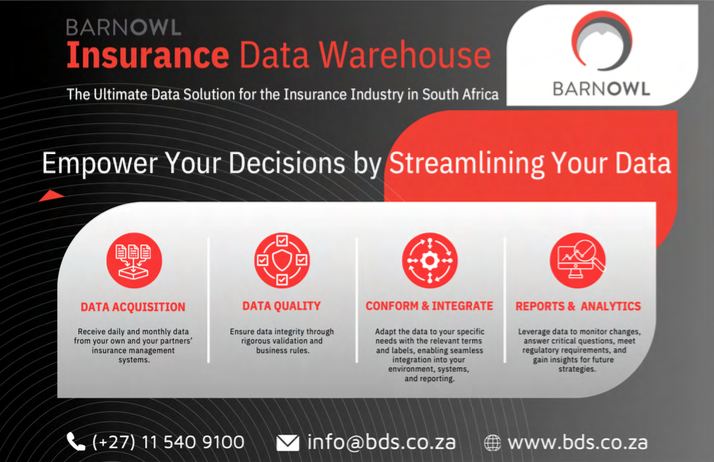
The Ultimate Data Solution for the Insurance Industry in South Africa

Empower your decisions by streamlining your data Data Acquisition Data Quality Conform & Integrate Reports & Analytics

Dashboard mockup