Short term
07 minutes

Leadership through discipline, not noise

In an environment defined by uncertainty and rising risk, leadership is tested through discipline rather than noise. Herman Scheepers reflects on why financial resilience, specialist focus and trusted broker partnerships are becoming the defining leadership qualities for insurers navigating 2026.
Written by
Herman Scheepers
Published on
February 13, 2026

Reflections on leading through uncertainty in 2026

Leadership in insurance is often tested most severely when growth is uneven, risk is rising, and certainty is in short supply.

The temptation in such moments is to chase scale, follow market noise, or reach for bold promises of transformation. Yet my experience over recent years has reinforced a different lesson: Sustainable leadership is less about dramatic moves and more about disciplined choices, made consistently, over time.

As we look ahead to 2026, the environment facing insurers, brokers, and underwriting partners remains complex. Economic pressure persists. Infrastructure constraints have not disappeared. Risk has become more specialised, more volatile, and more interconnected. In this context, leadership requires clarity of purpose, restraint in execution, and deep respect for the role that partnerships play in long-term resilience.

Strength is built before it is needed - One of the most important leadership lessons to emerge from our recent journey is that financial strength is not an outcome to be celebrated only in good times. It is a capability that must be built deliberately, often quietly, before conditions demand it.

Strong capital adequacy, disciplined claims management, and operational efficiency are not abstract balance-sheet concepts. They are leadership decisions that directly affect confidence, confidence among brokers placing complex risks, confidence among underwriting partners building specialist portfolios, and confidence among clients who expect certainty when claims arise.

As leaders, we are often tempted to prioritise growth narratives. Yet in a market like ours, credibility flows first from stability. The ability to support brokers consistently, honour claims efficiently, and absorb volatility without reactive behaviour is foundational to trust. In 2026, leaders who neglect this foundation will find their strategic ambitions constrained by reality.

Preserve identity while strengthening capability - Another defining leadership challenge is navigating growth without losing identity. Scale, integration, and access to shared infrastructure can unlock significant benefits, but only if they do not erode the human relationships that sit at the heart of insurance.

Our experience has reinforced the importance of separating capability from interface. Strengthening claims infrastructure, governance frameworks, and technical resources should enhance, not replace, accessibility and responsiveness. Brokers do not build trust with systems. They build trust with people who understand their context and can make decisions when it matters.

For leadership teams, this requires intentional design. Processes must empower decision-making rather than centralise it unnecessarily. Technology must support relationships rather than mediate them. In 2026, leadership will increasingly be judged on whether growth deepens trust or distances it.

“In a complex and evolving risk environment, disciplined leadership is not conservative. It is courageous.”

Herman Scheepers
CEO, Renasa insurance

Specialisation demands humility and focus - Risk in today’s environment does not reward generalisation. From fleet and heavy commercial vehicles to engineering, construction guarantees, and niche motor risks, complexity demands expertise.

Leadership in specialist underwriting environments requires humility, an acknowledgement that depth matters more than breadth, and that not every risk should be written simply because capacity exists. Saying no is often a leadership decision, not a commercial failure.

Disciplined underwriting, clear appetite definition, and strong technical partnerships protect not only the balance sheet but the ecosystem around it. Brokers rely on predictability. Underwriting managers rely on consistent frameworks. Clients rely on cover that performs as expected.

As we navigate 2026, leaders who prioritise expertise over volume will build businesses that endure, even if growth appears slower in the short term.

The broker remains central - Much has been written about technology, direct distribution, and automation. Yet one truth has remained constant: The broker’s role is becoming more important, not less, particularly in complex risk environments.

Brokers today are expected to be risk advisors, not intermediaries. That expectation places pressure on their own capabilities, but it also places responsibility on insurers to support that evolution meaningfully. Leadership in insurance must therefore recognise brokers as strategic partners, not transactional channels. This means investing in transparency, clarity of underwriting logic, risk surveys that inform real advice, and claims processes that protect broker reputation at the moment of truth.

In 2026, insurers that fail to understand this will struggle to retain quality intermediaries. Those that do will find brokers increasingly aligned to their long-term strategy.

Technology must serve judgement, not replace it - Technology has unquestionably improved efficiency and visibility. But leadership requires discernment in how technology is applied. Automation should remove friction, not context. Data should inform judgement, not override it. Systems must free skilled people to focus on decisions that require experience, nuance, and accountability.

In underwriting and claims, the most damaging failures rarely arise from lack of data. They arise from poor judgement applied at scale. Leadership in 2026 will require ensuring that technology augments human expertise rather than diluting responsibility.

Resilience is a leadership outcome - Ultimately, leadership is measured not by performance in ideal conditions, but by resilience through uncertainty. Resilience is built through financial discipline, consistent underwriting, trusted partnerships, and clarity of purpose.

As we look toward 2026, the insurance leaders who will make the greatest impact are unlikely to be the loudest. They will be those who focus on fundamentals, invest patiently, and lead with integrity when shortcuts appear tempting. In a complex and evolving risk environment, disciplined leadership is not conservative. It is courageous.

Five leadership principles for 2026

Insights from a discipline-led insurance journey

1. Build strength before you need it
Financial resilience, underwriting discipline, and claims capability are leadership choices, not accounting outcomes. Strength built quietly in stable periods is what allows confident decisions when conditions tighten.

2. Grow capability without losing identity
Scale and integration should strengthen service, not distance decision-makers from brokers and clients. Preserve accessibility while upgrading infrastructure.

3. Choose depth over breadth
Specialisation is not a niche strategy, it is a response to rising complexity. Leaders must be comfortable saying no to risks that fall outside their true expertise.

4. Treat brokers as strategic partners
In a complex risk environment, brokers are risk advisors, not distribution channels. Leadership means enabling their success through clarity, transparency, and reliable claims support.

5. Let technology serve judgement
Automation should remove friction, not accountability. The role of leadership is to ensure technology augments human expertise rather than replacing responsibility.

Renasa

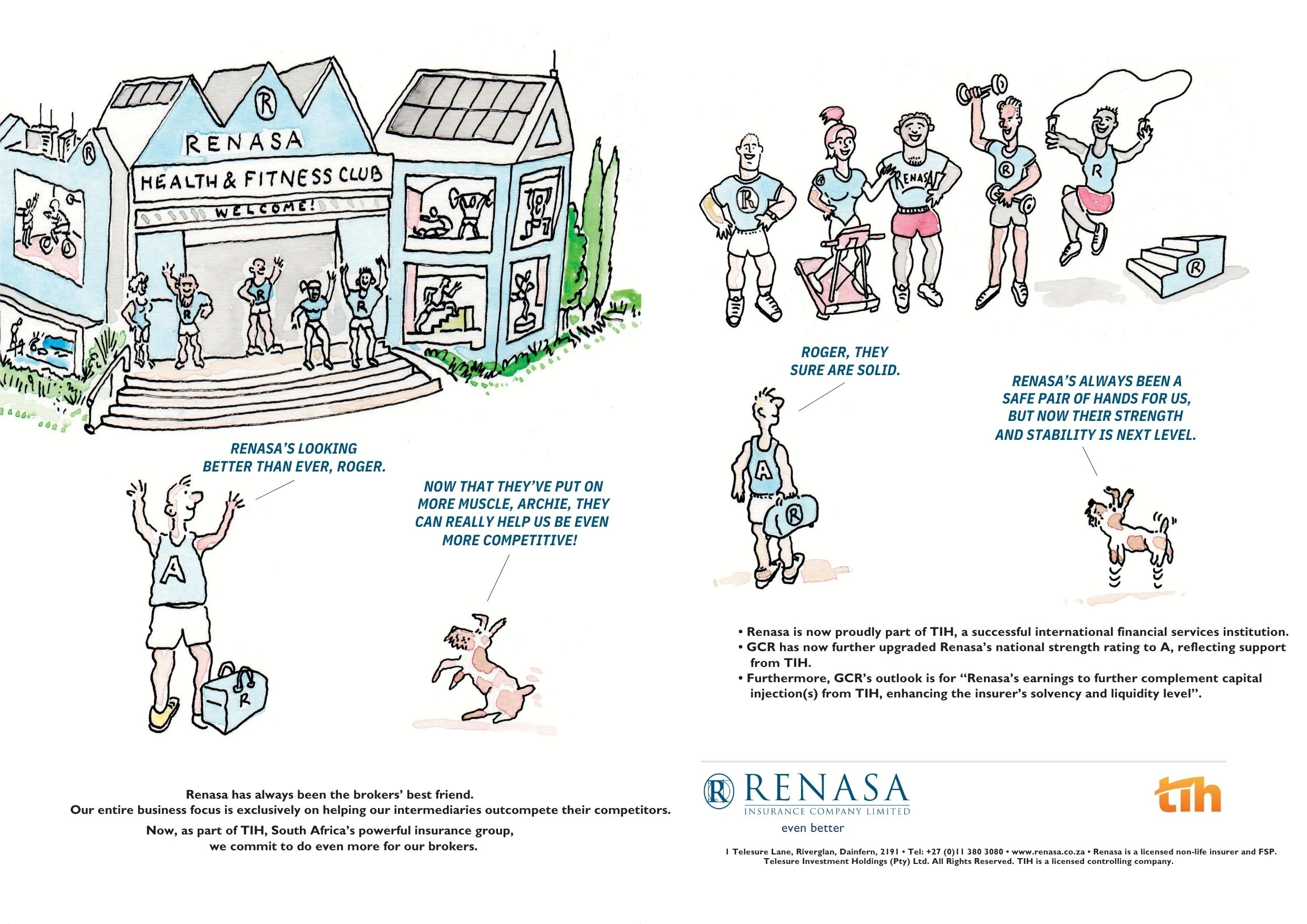
Our entire business focus is exclusively on helping our intermediaries outcompete their competitors. Now, as part of TIH, South Africa’s powerful insurance group, We commit to do even more for our brokers.
Renasa is a licensed non-life insurer and FSP. Telesure Investment Holdings (Pty) Ltd. All Rights Reserved. TIH is a licensed controlling company.