Technology
04 minutes

Leading in the Age of Agentic AI

South Africa’s 2026 insurance outlook shows cautious optimism, with modest premium growth, improving stability and evolving market fundamentals. Yet rising climate losses, talent shortages and increasing complexity demand a new kind of leadership, one capable of harnessing agentic AI to drive pricing precision, resilience and long-term competitiveness.
Written by
Adrian Mincher
Published on
December 9, 2025

South Africa enters 2026 at a moment of cautious but meaningful optimism. Economic growth is expected to strengthen modestly, supported by lower borrowing costs, gradual improvements in electricity stability, and long-awaited structural reforms in transport and pensions.

According to the Swiss Re Institute’s report “South Africa Outlook: Opening Pathways to Greater Resilience”, real non-life premium growth is projected at around 2 per cent in 2026, with motor insurance - representing 40 per cent of the market - expected to grow by 2.5 per cent as lower interest rates gradually revive vehicle sales. Property insurance, which accounts for 32 per cent of the market, is forecast to expand by 2.8 per cent as exposure values rise. Profitability prospects are also improving thanks to more stable claims patterns and steady investment yields.

Yet these positive indicators sit alongside meaningful challenges: structurally higher natural catastrophe losses, an 82 per cent overall protection gap for secondary perils, and a market where climatic shocks such as the KwaZulu-Natal floods continue to reshape risk appetite and pricing dynamics. At the same time, South Africa faces a long-term shortage of specialist insurance talent at precisely the moment when market complexity is increasing. In this environment, agentic AI offers both powerful operational uplift and a demanding test of leadership maturity.

For decades, leadership in insurance, particularly in mature markets like South Africa, has been defined by measured decision-making, linear processes and a bias toward caution. Risk was contained through hierarchy and tight control. It made sense in a system where change moved slowly and data flowed intermittently. Agentic AI disrupts that rhythm entirely. It accelerates decision cycles. It produces continuous evidence. It collapses multi-team workflows. And it reveals, with unflattering clarity, when leadership behaviours are slowing down organisations more than protecting them.

The companies moving fastest are not those with the most sophisticated models, but those whose leaders are willing to rethink their role. The shift is from command to orchestration: designing decisions rather than personally making them, empowering teams rather than bottlenecking them, and cultivating environments where experimentation is expected rather than quietly discouraged. This is particularly relevant in South Africa, where innovation often contends with legacy infrastructure, heavy regulatory responsibilities, and the operational realities of a diverse, multi-speed economy. Agentic AI does not remove these frictions; it demands leaders capable of navigating them with far greater fluency.

“Agentic AI offers both powerful operational uplift and a demanding test of leadership maturity.”

Adrian Mincher
Director of Insurance

I think pricing is a prime example of this leadership imperative in action. After years in which soft market conditions encouraged defensive behaviour, agentic AI has returned pricing to the strategic centre of the organisation. Leaders can now understand the impact of small price shifts on growth, loss ratios, capital exposure and customer fairness with unprecedented precision. They can adapt to interest rate movements that are reshaping annuity dynamics. They can respond to protection gaps, whether in long-term disability cover or climate-driven property exposures, with targeted, scenario-tested strategies. Pricing’s role is no longer purely technical; it is once again a senior leadership discipline.

This leadership shift is also essential in addressing South Africa’s widening skills gap. The country’s insurance sector faces a generational transition, especially visible in the life market where high penetration masks a small, concentrated customer base and a shortage of specialised expertise. Agentic AI will not reverse this trend, but it can cushion its impact by preserving institutional knowledge, documenting decision logic, and guiding younger professionals through complex judgments. Used wisely, AI becomes a modern apprenticeship tool, supporting capability development, not substituting for it. But its effectiveness depends entirely on leadership that invests in people as deliberately as it invests in technology. AI may buy time, but it cannot secure the future without a strong talent pipeline.

Underlying all of this is a growing recognition that data sovereignty is not a compliance chore but a strategic necessity. As South African insurers expand into hybrid products under new pension rules, or experiment with parametric covers in response to floods and droughts, they will rely increasingly on region-aware, purpose-bound data frameworks. Leaders who build for sovereignty upfront will avoid cross-border friction, protect consumer trust and enable agentic systems to operate safely in a highly regulated environment.

South Africa’s insurance outlook is characterised by resilience: moderate growth, improving operational fundamentals, and significant long-term opportunities in areas such as simplified protection products and climate resilience. But capturing that opportunity will not be determined by technology alone. It will depend on whether the sector’s leaders can evolve as quickly as the tools now at their disposal.  

The AI Underwriter is here, but it does not eliminate the need for judgment, accountability or vision. If anything, it makes them more important. Agentic AI is not replacing leadership; it is revealing where leadership needs to change.

Adrian Mincher
Earnix
A career centred on Insurance and reinsurance spanning over 25 years as a practitioner and in Insurance IT both in the UK and overseas markets.
Connect with author

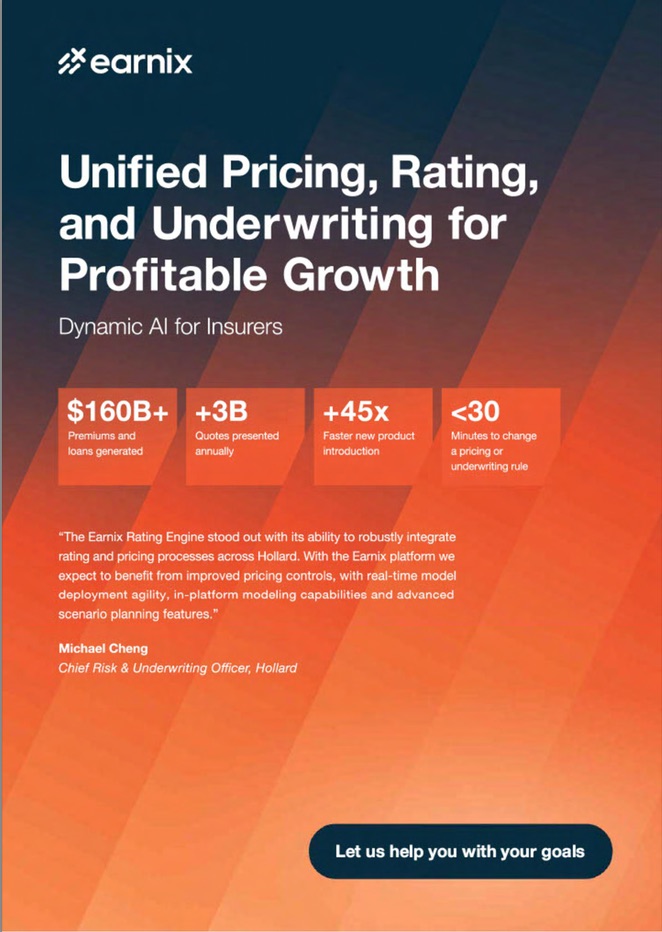
Unified Pricing, Rating, and Underwriting for Profitable Growth.

The Earnix platform provides integrated predictive, generative, and agentic AI to power intelligent decisioning across the full underwriting, pricing, rating, and personalisation cycle. Our leading platform helps insurers and banks optimise and perform with agility.

Dashboard mockup