07 minutes

Making medical aid work harder

Fedhealth’s Jeremy Yatt argues that medical schemes must evolve from crisis payers to prevention partners.
Written by
Jeremy Yatt
Published on
November 11, 2025

South Africa’s medical schemes were born out of mutuality: a collective pool where members contribute so that anyone facing a health event can draw on shared funds.  

That ethos remains the bedrock of today’s not-for-profit schemes, even as affordability pressures and policy uncertainty intensify. In a wide-ranging conversation, Jeremy Yatt, Principal Officer at Fedhealth (by Sanlam), argues that the future of medical cover hinges on two ideas: shifting from crisis response to prevention, and giving members meaningful flexibility without adding friction.

Yatt starts with first principles. Medical schemes do not exist to generate shareholder returns; their “shareholders” are members. Value, therefore, is measured in reliability at critical moments and in the long tail of better health. Healthcare generates unusually rich data and frequent touchpoints, on average, members interact with a scheme multiple times a month, creating a powerful opportunity: use data and design to prevent crises, not only fund them. Screenings, regular check-ups and early interventions, funded by defined benefits, are not window dressing; they are the cheapest, most humane path to sustainable claims costs. Managing blood pressure, cholesterol and pre-diabetes today avoids strokes, amputations and catastrophic expenses tomorrow.

The strategic alignment with Sanlam extends that logic beyond the clinic. Health risk does not live in a silo; it compounds or erodes financial security. “Aligning health benefits with financial products,” Yatt explains, allows members to avoid liquidating assets under medical duress and helps insurers price risk more accurately. The goal is not to reward only the already-fit, but to nudge the average person toward better habits and supported treatment adherence, because it is clinically sound and fiscally prudent.

Affordability remains the pressure point. Traditional option design forces consumers up the price ladder to access day-to-day benefits through fixed annual “savings” allocations. That rigidity fails many households: some chronically under-use the pot and overpay, others deplete it by March and limp through the year. Fedhealth’s response is modularity. Members can start with a hospital plan, covering insurable, high-severity events, and then dial up day-to-day funding only when needed. If your glasses break, you can unlock funds at that moment and pay them back over time, interest-free, rather than carrying an expensive upfront savings allocation all year. For families with tight month-end cash flow, that on-demand mechanism can be the difference between timely care and delayed treatment.

Flexibility also extends to how members hedge against provider pricing gaps. Network arrangements negotiate rates; when a provider charges more than the scheme rate, a co-payment arises. Pairing a plan with structured self-payment gaps and separate gap cover can, for many, reduce monthly contributions while preserving access when big procedures arrive. Yatt’s own family configures comprehensive hospital cover with co-payments, backed by gap cover and occasional use of the scheme’s day-to-day funding wallet, illustrates how members can assemble cover around likely needs (for example, joint issues) without paying permanently for everything they may never use.

“We must keep the mutuality, modernise the mechanics, and make prevention the core purpose.”

Jeremy Yatt
Principal Officer at Fedhealth

With flexibility comes complexity - That is where digital user experience matters. Younger members, in particular, gravitate to app-first administration, topping up day-to-day funds instantly for a dependent’s dental procedure, for example, without call centre friction. Done well, this reduces stress at the point of care and turns cover design into a dynamic tool rather than a once-a-year gamble.

Policy context inevitably looms, and Yatt is explicit. He supports the principle of universal access to quality healthcare as a measure of a country’s sophistication. But he is sharply critical of the National Health Insurance model as currently framed, both for its likely practical effects and for the way it is being advanced. In his view, sweeping the entire population into a single state-run funding and purchasing system will inevitably mean rationing by waiting lists and reduced choice, an experience already familiar in other national systems.

Today, even without medical aid, many serious conditions in urban centres (such as heart attacks and certain cancers) can access high-quality public tertiary care; where the state system struggles is in everyday medicine and basic infrastructure. Over-centralising funding while crowding out well-run, member-governed, not-for-profit schemes risks adding demand to a system whose main problems are management, maintenance and accountability.

Yatt argues there is a more constructive route to universalism that leverages, rather than sidelines, the private risk pool. Several levers stand out. First, broaden participation in schemes by introducing income-linked mandatory membership above a reasonable earnings threshold, so the healthier and younger expand the pool and bring average costs down.  

Second, permit more flexible benefit design instead of prescribing an ever-expanding list of must-pay items at any cost, which can drive over-servicing and defensive medicine.  

Third, implement long-standing Health Market Inquiry recommendations aimed at price transparency, clinical coding standards and procurement efficiency. In that scenario, those who can and wish to self-fund through schemes do so, freeing scarce public resources for the most vulnerable, while the state focuses on governance and quality in facilities, rather than owning every funding decision.

His critique is not a defence of the status quo. Yatt is clear that schemes must keep proving their social value: they are not-for-profit entities run by trustees on behalf of members, not profit-maximising insurers. When industry bodies such as the Health Funders Association and the Board of Healthcare Funders oppose parts of the NHI legislation, they do so, he says, because the model on the table is likely to harm members, by reducing choice, degrading service levels and raising system-wide risk, rather than because schemes are “protecting vested interests”. In his framing, the real “vested interest” is the member’s health and financial stability.

Data underscores the case for prevention - Fedhealth’s analysis shows that members who fail to adhere to chronic medication, such as antihypertensives, cost the scheme materially more over time than adherent members. That is not a moral judgment; it is a measurable risk signal. Proactive programmes, reminders, outreach, integrated benefits, are therefore both compassionate and financially sound.

The through-line is simple. If medical schemes are to remain viable for the many rather than the few, they must deliver three things at once: uncompromising cover for the big, insurable events; real-time flexibility for everyday care without waste; and relentless focus on prevention powered by data and design. Fedhealth’s Sanlam partnership frames that as a single continuum of wellbeing and wealth.  

In a system under strain, it is a practical blueprint: keep the mutuality, modernise the mechanics, and make the app do the heavy lifting, while insisting that reform builds on what already works.

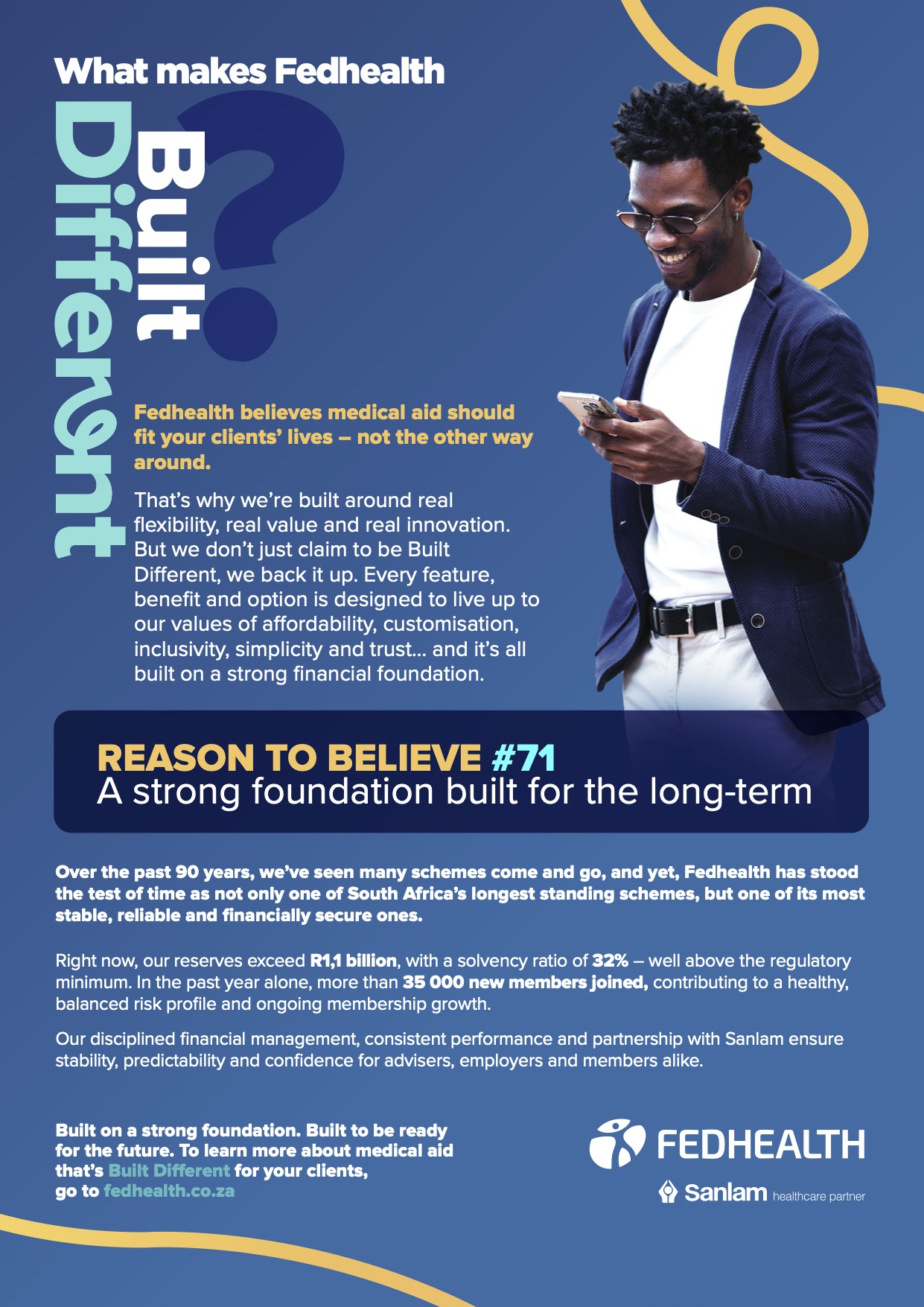
Built different

Fedhealth believes medical aid should fit your clients’ lives – not the other way around. Built on a strong foundation. Built to be ready for the future. To learn more about medical aid that’s Built Different for your clients, go to fedhealth.co.za

Dashboard mockup