South Africa is one of the most insurance-intensive economies globally – with penetration at ~11–12% of GDP in 2024, it is on par with or above countries like the UK and USA in this metric. And it is a market at a critical turning point. Rising climate shocks (The 2022 KwaZulu-Natal floods were a stark example – they caused an estimated US$1.57 billion in infrastructure damage alone, the largest natural catastrophe loss on record in the country), cyber threats, and economic volatility are testing traditional models.
At the same time, customers are asking for something quite different from what many insurers have been set up to provide: simple, personalised, and responsive fully digital service. If insurers are to keep pace, customer engagement needs to evolve just as quickly as the risks we are asked to cover.
Insurance does more than pay claims. It underpins housing markets, enables investment, and allows businesses to take risks that drive growth. When insurance becomes unavailable or unaffordable, as is already happening in some parts of the world, the ripple effects are severe. Property markets seize up. Financial systems falter. The lesson for South Africa is clear: insurers are not only risk managers, but also a foundation of economic resilience.
This role is being recognised globally. The World Economic Forum has described insurers as “resilience builders”, mobilising capital and helping economies recover. To live up to that role in South Africa, insurers must strengthen their ability to engage with customers in ways that are faster, more transparent, and more tailored to individual needs.
The Barriers to Change - There is no shortage of ambition in the market. The challenge is execution. Legacy systems still slow down simple adjustments. Many carriers report that even routine product updates can take months, which means they struggle to respond to shifting market dynamics. Organisational silos, where underwriting, pricing, and distribution all operate on different tracks, add another layer of friction.
Talent is another concern. Experienced underwriters are retiring, while younger professionals expect digital tools that support smarter, faster decisions. At the same time, new risks like cybercrime and extreme weather don’t always come with the historical data needed for traditional modelling. The result is a sector that knows it must change but often finds the path forward blocked.
Learning from Other Industries - There are useful lessons from elsewhere. In capital markets, digitisation transformed operations, cutting out delays and unlocking new growth. The firms that came out on top weren’t those with the deepest legacy systems, but those that modernised how they worked. Insurance is now facing a similar inflection point. Technology is only part of the solution. The bigger question is how insurers adapt their culture, operating models, and decision-making processes to serve customers in a more dynamic environment.
One area of progress is in customer engagement. With better use of data and intelligent decisioning, insurers can move away from generic offerings and towards tailored experiences. Earnix’s recent work with intelligent decisioning platforms shows how this can be done responsibly. By combining predictive analytics with governed workflows, insurers can adjust pricing, launch new products, and respond to customer needs in real time, without compromising compliance.
We’ve also seen the benefits of embedding tools directly into front-line operations. For example, our Customer Engagement Platform uses advanced analytics to recommend the next best action in live interactions. Whether that means offering a personalised renewal discount, prompting an upsell, or guiding a claims discussion, the result is a smoother customer journey and better business outcomes.
At Excelerate 2025, we introduced new solutions such as AI Studio, which allows insurers to safely embed AI agents into decisioning workflows, and Elevate Data, which simplifies the integration of proprietary and third-party data. These aren’t experiments in a lab, they are tools already being put into production by insurers seeking to improve speed to market and customer satisfaction.
Why South Africa Can Lead - As we move toward 2026, South African insurers will face a sharper convergence of market pressure, regulatory tightening, and customer demand. The time to act is now, because the horizon is drawing nearer.
One of the most consequential developments is the drive to strengthen liquidity and capital stress testing. In South Africa, the Prudential Authority is increasingly emphasising more granular liquidity risk frameworks, meaning insurers will need more robust, forward-looking modelling and governance of cash flows.
Also of interest is a recent tax court judgment, from December 2024, which affirmed that risk transfer arrangements (such as contingency or parametric insurance) should be treated as insurance in certain contexts. That ruling opens the door to more creative product design - but also greater tax and regulatory scrutiny. In short: regulators are watching newer models more closely, and some of the guardrails used abroad may start to translate locally.
Together, this suggests that 2026 could become a pivot year: one in which regulators begin transforming permissive innovation into mandatory guardrails.
Given this likely tightening, the path to leading in customer engagement will require more than incremental change. For South Africa’s insurers, the task is urgent but achievable. The same forces shaking up global markets - rising climate volatility, generational change in skills, the push toward embedded financial services - are accelerating locally.
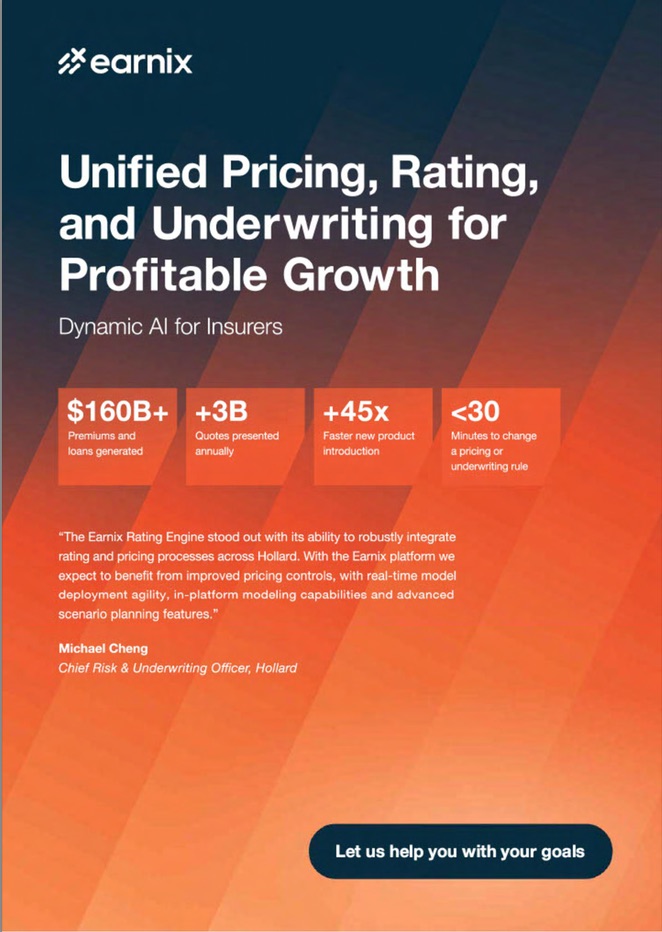
The Earnix platform provides integrated predictive, generative, and agentic AI to power intelligent decisioning across the full underwriting, pricing, rating, and personalisation cycle. Our leading platform helps insurers and banks optimise and perform with agility.