Technology
06 minutes

The race to reinvent: Key trends shaping insurance in 2026

The insurance industry is entering a critical phase of transformation as AI, data challenges, regulatory demands and rising customer expectations reshape the competitive landscape. Insurers that modernise quickly and embed intelligent decision-making will gain a decisive advantage in the race to reinvent.
Written by
Tony van Niekerk
Published on
March 26, 2026

The global insurance industry is entering what many executives describe as one of its most pivotal moments in decades.

A combination of technological disruption, regulatory complexity, and rapidly evolving customer expectations is forcing insurers to rethink how they operate, compete, and innovate.

A recent industry report, “The Earnix 2026 Industry Trends Report: The Race to Reinvent,” highlights the forces reshaping the sector and the strategic priorities that insurers must address to remain competitive. Drawing on a survey of 400 global insurance executives, the research paints a clear picture: the pace of change is accelerating, and insurers that move quickly to modernise their decision-making capabilities will gain a significant competitive advantage.  

While the report explores a range of themes, four trends stand out as defining the next phase of the industry’s evolution.

AI moves from experimentation to core strategy - Artificial intelligence has been part of the insurance conversation for several years, but the industry now appears to have crossed a critical threshold. According to the research, 81% of insurers report that AI is already integrated into their workflows, either across most functions or in selected operational areas.  

This shift reflects a growing recognition that AI is not simply a technology experiment but a strategic capability that can transform core insurance processes. From pricing and underwriting to claims processing and customer engagement, AI is enabling insurers to process vast volumes of data and generate insights that were previously impossible to identify.

However, the report also highlights an important reality: adoption does not necessarily mean maturity. Despite widespread experimentation, fewer than a third of insurers currently use AI extensively in areas such as claims processing, policy issuance, or customer retention modelling.  

This gap suggests that many organisations are still in the early stages of integrating AI into their operational frameworks. The next challenge will be moving beyond pilot projects toward scalable, enterprise-wide implementation.

At the same time, insurers remain cautious. More than half of executives favour a gradual adoption approach, maintaining human oversight in decision-making for the foreseeable future. This hybrid model reflects the need to balance automation with governance and accountability.

Compliance becomes a strategic driver - Regulation has always been a central feature of the insurance industry, but the report suggests that compliance is now evolving from an administrative obligation into a strategic capability.

As regulators introduce new frameworks around AI governance, data privacy, and financial oversight, insurers are under increasing pressure to ensure that their technology deployments remain transparent and accountable.

Nearly all insurers now conduct regular reviews of their AI governance frameworks, yet only a minority of executives believe their current oversight processes are sufficient to keep pace with regulatory demands. Regulatory and legal exposure has therefore become the leading ethical concern associated with AI adoption, followed closely by challenges related to explainability and transparency.  

Rather than viewing regulation purely as a constraint, the report suggests that insurers can treat compliance as a catalyst for innovation. Embedding governance and transparency into technology platforms can strengthen trust with regulators and customers while enabling organisations to scale AI initiatives more confidently.

In this context, compliance becomes not just a defensive necessity, but a foundation for sustainable growth.

“The race to reinvent insurance will be won by those who combine AI, data and governance to deliver faster, smarter and more personalised decisions.”

Tony van Niekerk
Editor, COVER

Data quality emerges as the industry’s biggest challenge - If AI is the engine of modern insurance, then data is the fuel that powers it. Yet the report reveals a persistent challenge across the industry: insurers are investing heavily in data and analytics capabilities, but many still lack confidence in the quality and reliability of their data infrastructure.

A striking 83% of executives say they are concerned that their AI models may be trained on incomplete or inaccurate data, highlighting the risks associated with poor data governance. This concern is reinforced by the finding that two-thirds of executives believe poor data quality slows decision-making and limits the effectiveness of AI initiatives.  

To address these gaps, insurers are increasingly turning to new data sources. Telematics, IoT devices, third-party datasets, and behavioural data are all emerging as important inputs for more sophisticated risk modelling and product design.

At the same time, the report points to the growing popularity of innovative insurance models such as usage-based and highly personalised policies, which rely heavily on richer data streams and advanced analytics. For insurers that successfully harness these capabilities, data can become a powerful strategic asset.

Customer expectations reshape the competitive landscape - Perhaps the most significant shift highlighted in the report is the changing nature of customer expectations. Today’s policyholders increasingly compare insurers not only with traditional competitors but also with the digital experiences offered by technology and retail companies.

Fast, personalised, and transparent interactions are no longer optional. Digital engagement is now considered the baseline for customer experience, and insurers are investing heavily in self-service platforms and digital channels to meet these expectations.  

However, personalisation remains a key challenge.

Only about one in four insurers currently deliver personalised experiences at scale, despite strong evidence that tailored engagement significantly improves customer loyalty.  

External research cited in the report suggests that up to 80% of customers would consider switching insurers to obtain more personalised services, highlighting the competitive importance of customer-centric strategies. For insurers, this means that experience design is becoming just as important as pricing and risk assessment.

Reinvention is no longer optional - Taken together, the trends outlined in the report point to a clear conclusion: the insurance industry is entering a new phase of transformation. Artificial intelligence, data innovation, regulatory change, and evolving customer expectations are converging to redefine how insurers operate.

Organisations that modernise their systems, strengthen their data foundations, and integrate AI responsibly will be better positioned to respond to this rapidly changing environment. Those that hesitate risk falling behind more agile competitors.

The report ultimately frames the coming years as a race to reinvent the insurance enterprise, where speed, adaptability, and intelligent decision-making will determine long-term success.

Source:
Insurance 2026: The Race to Reinvent report by Earnix in collaboration with Market Research Group.

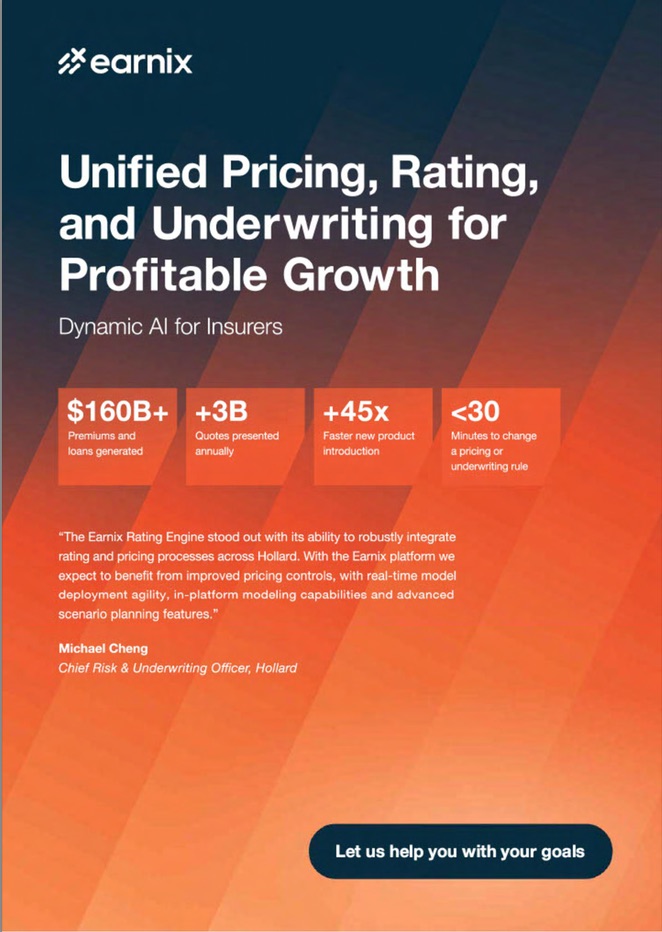
Unified Pricing, Rating, and Underwriting for Profitable Growth.

The Earnix platform provides integrated predictive, generative, and agentic AI to power intelligent decisioning across the full underwriting, pricing, rating, and personalisation cycle. Our leading platform helps insurers and banks optimise and perform with agility.

Dashboard mockup