Why income continuity is becoming a central advice conversation in 2026

As South Africa’s disability and sickness insurance gap widens, income continuity is emerging as a core advice priority in 2026. The shift reflects a growing recognition that illness disrupts earnings over time, not as a once-off event.
Written by
Wimpie Mouton
Published on
February 23, 2026

As South Africa moves through 2026, the conversation around sickness and permanent incapacity is shifting. What once appeared to be a product shortfall is increasingly revealing itself as a broader advice challenge. The country’s sickness and permanent incapacity insurance gap has grown to an estimated R50.4 trillion, more than seven times national GDP¹. For financial advisers, this points to a widening gap between what clients believe they are adequately protected against and the financial reality of prolonged illness or injury.

This trend has been building steadily. The disability insurance gap has widened by around 12.5% a year since 2021. While incomes, professional responsibilities and household commitments have increased, many clients’ protection arrangements have remained largely unchanged². The result is meaningful exposure sitting quietly within financial plans that otherwise appear sound.

The gap becomes even clearer when the focus turns to a client’s ongoing ability to earn an income. On average, South African income earners hold about R1.2 million in disability cover yet would need closer to R3 million to maintain their standard of living if illness or injury limited their capacity to work. From an income protection perspective, most existing policies replace only 39% to 45% of the income required when a primary earner becomes disabled³.

Actuarial data suggests this is not a marginal risk. Approximately 145 income earners are expected to become disabled every day throughout 2025 and 2026. For financial advisers, this significantly increases the likelihood that clients will face extended periods of income disruption, often without adequate financial continuity built into their planning.

These figures highlight why protection conversations need to be centred on the ability to earn an income, rather than treating disability as a once-off event. Clients experience illness as a period of reduced or interrupted earning capacity, often over months or even years, and advice needs to reflect that lived reality.

In response, insurers are adapting how protection is structured, placing greater emphasis on preserving income over time rather than relying solely on lump-sum payouts. This reflects the reality that households depend on steady cash flow to meet everyday commitments, from bond repayments and education costs to professional and business expenses.

“The real advice opportunity in 2026 lies in helping clients understand that their ability to earn an income is often their most valuable asset.”

Wimpie Mouton
Chief Executive Officer of Professional Provident Society Life Solutions

There has also been a renewed focus on flexibility. Short seven-day waiting periods have returned to the market to better support freelancers, self-employed professionals and those in the gig economy, where even brief periods of illness can quickly place pressure on cash flow. For financial advisers, these options enable more practical discussions around recovery timelines and short-term financial resilience.

In the broader profession-specific benefits are also gaining relevance. These assess medical inability to work rather than requiring proof of a defined loss of income, an important distinction for self-employed professionals, partners and practice owners whose earnings are not always easily quantified. This approach aligns more closely with how work and income are disrupted and remains a key consideration in advice-led planning.

Cost pressures continue to influence client decision-making. Medical scheme weighted average increases for 2026 are expected to range between 6.8% and 9.9%, well ahead of general inflation. In response, insurers are embedding preventive-focused features into their offerings, using digital tools and data insights to promote earlier intervention, healthier behaviours and better long-term outcomes. The aim is to reduce the risk of permanent incapacity while keeping cover sustainable.4,5,6

Policy uncertainty adds another layer of complexity. Although the National Health Insurance Act 20 of 2023 was signed in 2024, its implementation path in 2026 remains unclear due to ongoing legal challenges. For many clients, this uncertainty has reinforced the importance of maintaining private sickness and incapacity cover as a non-negotiable safeguard of their earning ability. 4,5,6

At the same time, digital transformation is reshaping expectations around service and claims. Automation and mobile platforms now allow for faster claims processing, with some insurers offering same-day payouts for minor sickness claims. These developments are becoming increasingly relevant factors for financial advisers when assessing product suitability and the overall client experience.

The real advice opportunity in 2026 lies in helping clients understand that their ability to earn an income is often their most valuable asset. When protection strategies are built around income continuity and recovery, advisers are better positioned to deliver advice that holds up under real-world pressure.

For financial advisers, the challenge, and the opportunity, is to ensure comprehensive protection planning evolves in step with how clients work, earn and sustain their livelihoods in an increasingly complex economic and health environment.

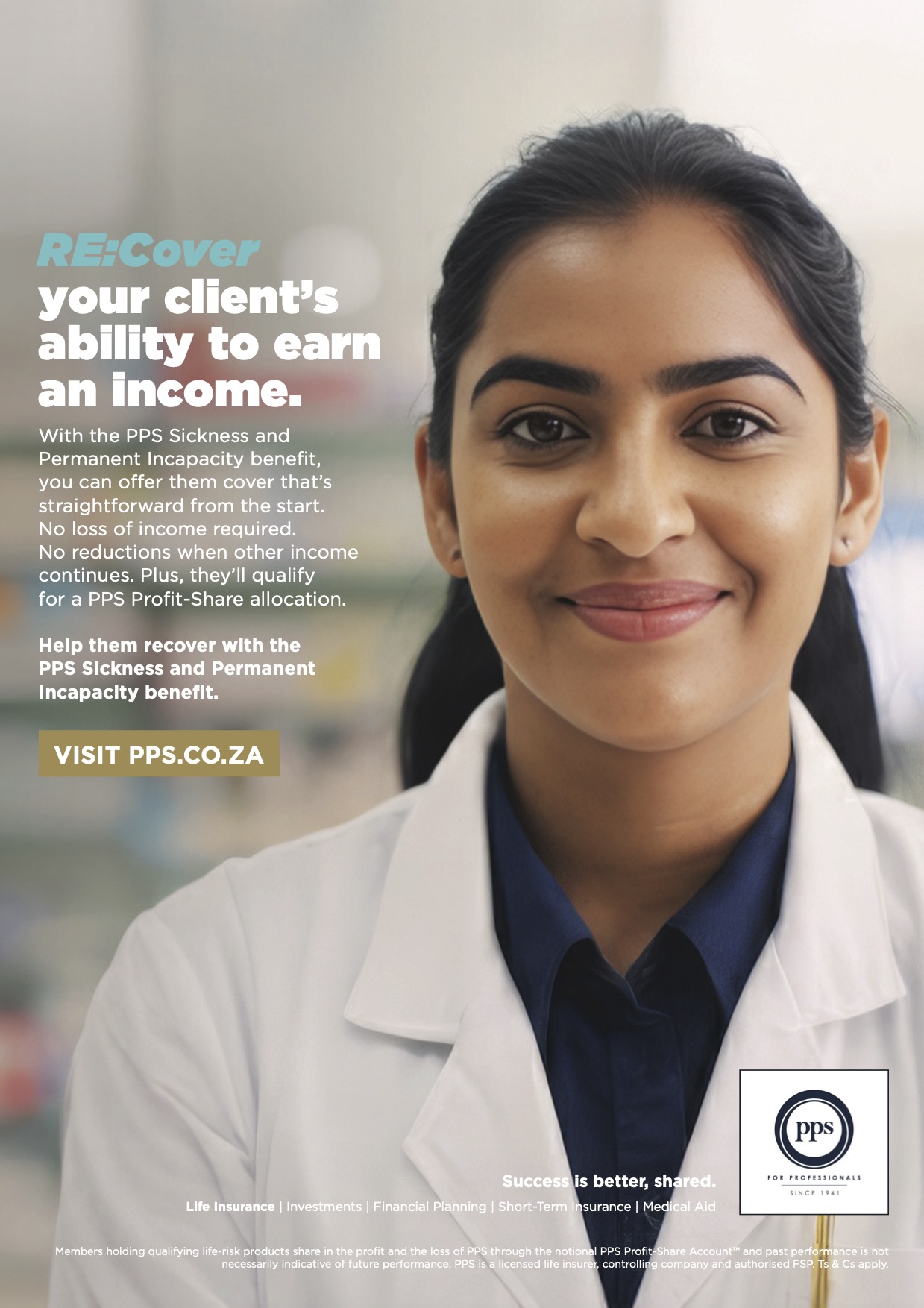
WHAT IF YOU STRESSED LESS WHEN YOUR CLIENT NEEDS TO CLAIM?

BE STRESSLESS, WITH THE PPS SICKNESS AND PERMANENT INCAPACITY BENEFIT

*Members holding qualifying life-risk products share in the profit and loss of PPS through the notional PPS Profit-Share AccountTM, which vests on retirement from age 60 or death. Past performance is not necessarily indicative of future performance. PPS is a licensed insurer conducting life insurance business, a licensed controlling company and an authorised FSP. Ts&Cs apply.

Dashboard mockup