
What SA's wealth index revealed
What you do with your money matters more than what you earn
New data in one of the largest financial wellbeing surveys has a surprising message for South Africans: the biggest driver of financial wellbeing isn't a higher income. Rather, it's the habits built around the income you already have. That is the central finding of the inaugural Franc Wealth Index, a landmark study of almost 4,000 South Africans that reveals the habits, behaviours and mindsets shaping the financial lives of ordinary people across the country.
The research, conducted in February and March 2026, by Franc, a digital wealth coach and investment platform, found that those with strong financial habits, including investing regularly, budgeting consistently, and setting and reviewing financial goals, are two to three times more likely to score well on a holistic measure of financial wellbeing than those who simply earn more.
Two behaviours were particularly significant in the data. Addressing these two issues, the data suggests, unlocks progress across the entire financial ecosystem. Firstly, carrying high debt doesn’t just drag down a person’s debt score, it also significantly worsens their savings behaviour, investment activity, financial anxiety and emergency preparedness.
Secondly, the absence of an emergency fund not only leaves people exposed to financial shocks but also makes them measurably less likely to save, invest, or feel calm about money.
The primary author, Dr Thomas Brennan, CEO and founder of Franc, stated that the development of the Franc Wealth Index was born from his time at Discovery, where he saw how Vitality Age – a single number summarising complex health data – transformed how people understood and managed their physical health. "When you make the intangible tangible, behaviour changes," said Brennan. "Financial wellbeing needed its own version of that.”
“We built the Wealth Index because we wanted to go beyond the numbers on a bank statement,” said Brennan. “The most important thing this data tells us is that financial wellbeing is not a reward for earning enough, but rather the result of building the right habits. That is empowering, because habits are something every South African can work on, regardless of the number on their payslip.”
The Franc Wealth Score – the methodology underpinning the index – measures financial wellbeing across three pillars: Resilience (financial preparedness, savings and debt), Growth (investing, planning and retirement behaviour) and Mindset (financial confidence and anxiety). South Africa’s inaugural score of 45 out of 100 sets a national benchmark, providing a baseline against which progress can be tracked.
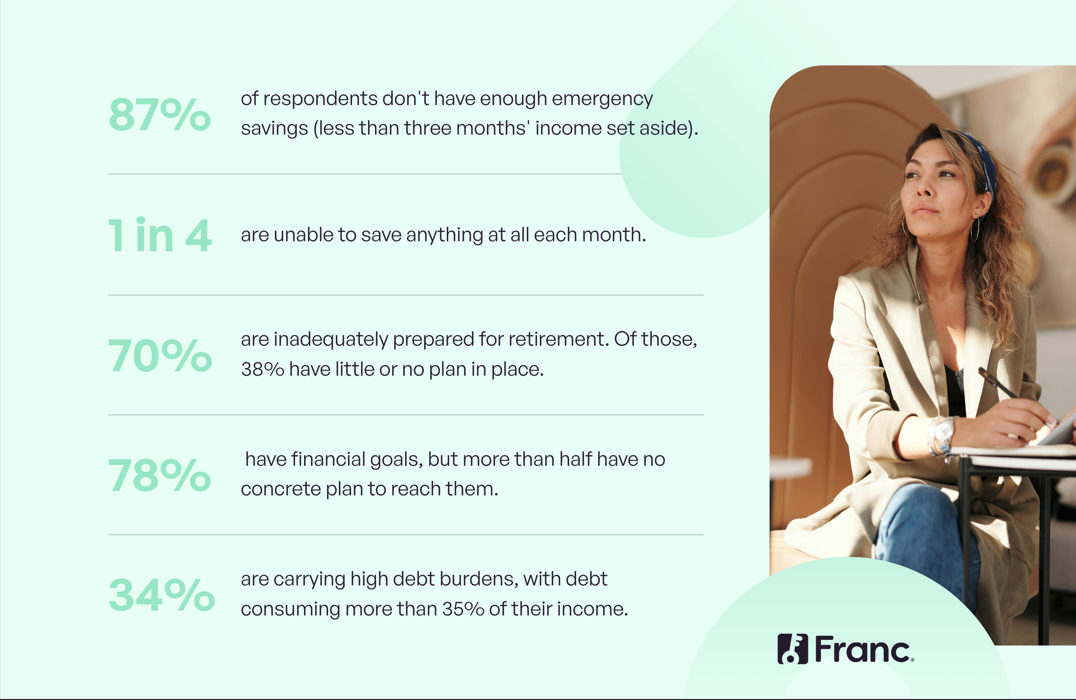
The findings paint a picture of a country caught between awareness and action. South Africans are not financially indifferent; 64% rate their investment knowledge as intermediate or above, and 78% report having financial goals. Yet only a fraction have the structural habits to back that intent. Only 13% of respondents had adequate emergency savings, the single most foundational measure of financial stability. One in four respondents is unable to save anything at all each month. And 70% are inadequately prepared for retirement.
“The gap between knowing and doing is the defining challenge for financial wellbeing in South Africa,” said Brennan. “South Africans are not disengaged or uninformed. They are anxious, and that anxiety makes it harder to act.”
The Franc Wealth Score is available now at franc.app/tools/wealth-score. South Africans can take a free, three-minute Wealth Score check to understand where they stand across Resilience, Growth and Mindset and receive personalised guidance on what to focus on next. Users of the Franc app can save and invest directly in a range of funds while building the habits the data shows make the biggest difference. The full Franc Wealth Index Report 2026 is available for download at www.franc.app/learn/wealth-index-report