
2024 Industry Results from Health Quality Assessment
By: Louis Botha, CEO of HQA
MEASURING QUALITY FOR A SUSTAINABLE HEALTHCARE SYSTEM

Ensuring quality in healthcare is essential for the sustainability of the health sector. It plays a crucial role in patient health outcomes, patient safety and the efficient functioning of the health system. Health Quality Assessment (HQA), a non-profit and public benefit organisation, has once again measured and reported on healthcare quality across 83% of medical scheme members in South Africa. This encompasses over 200 health quality indicators, including primary care, maternity and newborn care, chronic disease management, and hospitalisation indicators.
On Friday, 16th August 2024, HQA presented its 20th consecutive annual Industry Report on the quality of healthcare in South Africa. This year's report is based on data from medical schemes representing 104 benefit options and covering 83% of all insured beneficiaries, totalling 7.43 million lives. The analysis included a comprehensive review of 200 health quality indicators.
Key Findings
The 2024 data analysis, drawn from claims data up to the end of 2023, reflects a balanced demographic with 3.37 million male and 4.05 million female beneficiaries. The average age of the insured population is now 35.0 years, marking an increase of 3.0 years over the last thirteen years. The increasing prevalence of chronic diseases continues to be a significant concern, with 12.16% of beneficiaries registered for chronic benefits with hypertension (up by 0.71% since 2010), 4.29% with HIV (up by 2.10% since 2011), and 4.61% with diabetes (up by 1.28% since 2010). Overall, 25.30% of beneficiaries have at least one chronic condition.
Positive Trends and Areas of Concern
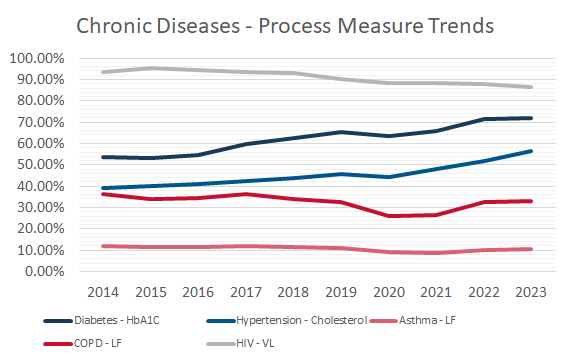
According to Louis Botha, CEO of HQA, the 2024 report indicates encouraging progress in several areas, such as flu vaccine coverage, HIV testing and screening, and antenatal screening. Additionally, there has been significant improvement in the management of metabolic diseases, with coverage of key disease management metrics for diabetes and hypertension increasing by more than 25% since 2010. However, Botha also highlighted areas requiring further attention, including mental health screening and asthma lung function tests, where limited to no progress have been made.
Primary Care Successes
A notable trend over time is the increase in flu vaccine uptake among members over 65, from under 15% in 2013 to almost 20% in 2023. Dr Unben Pillay, HQA Director and CEO of the Alliance of South African Independent Practitioners Association (ASAIPA) and a speaker at the event, attributes this success to a concerted effort by both medical schemes and primary care doctors to encourage flu vaccination among patients.
Non-Communicable Diseases (NCDs)
Statistics from the 2020 Mortality and Causes of Death report by Statistics South Africa identified diabetes, primarily Type 2, as the leading cause of death from natural causes (after COVID-19). By 2040, it is estimated that 8.75 million South Africans will be affected by diabetes. Against this backdrop, it is promising that HQA's results show a significant increase (over 25%) in diabetes monitoring (via the HbA1C test), supporting the effective management of diabetes patients.
Preventative Screening
Despite the availability of benefits from many medical schemes, there has been little progress in the number of women aged 50-74 accessing mammography services. This has sparked some schemes to take proactive steps to estimate the risk of developing breast cancer. For those at higher risk, additional screenings such as MRI scans are available.
Maternity Care
Since 2010, the rate of C-sections has risen slowly but remains high, with 75.81% of deliveries among participating medical schemes being by C-section. This high rate correlates with a 3.1% increase in neonatal ICU admissions. Most babies delivered before 38 weeks require NICU care due to complications. Schemes are increasingly working with Obstetricians to address the potential unnecessary delivery of pre-term babies and to reduce the risk of complications and NICU admissions. To better understand these indicators, HQA is considering adding an indicator for gestational age at the time of C-section in future reports.
Hip and Knee Replacements
The duration of hospital stays for hip and knee replacements has decreased, reducing the risk of complications such as deep vein thrombosis (DVT). This improvement is partly due to the introduction of new clinical pathways. While readmission rates for knee replacements have slightly decreased, there has been a concerning uptick in readmissions following hip replacements.
Asthma Management
South Africa ranks 25th worldwide for asthma prevalence and 5th for asthma-related deaths. The decline in lung function testing for asthmatics by nearly 3.5% since 2010 is troubling. Moreover, while nearly 50% of asthmatics are on controller therapy, compliance remains low.
Pneumonia
There has been a noticeable decrease in hospital admissions due to pneumonia, likely due to increased awareness of infection control measures, such as mask-wearing and hand washing during flu season.
Conclusion
HQA’s results provide valuable insights into the state of healthcare in South Africa. However, these findings should be interpreted with caution, as various factors contribute to the performance of specific quality indicators. The healthcare system is complex, and multiple elements influence the quality-of-care patients receive. What remains critical is that these results are shared with HQA participants and stakeholders to drive continuous improvement.