
To Hedge, or Not to Hedge
Daniel Malan, CFA, Founder, Managing Director & Chief Investment Officer, Perspective Investment Management
On April 20th, 2020, the oil price – to be precise, the West Texas Intermediate (WTI) crude oil futures contract – briefly declined to below zero. While theoretically possible, this was considered an event with no realistic chance of ever actually occurring. But it did. To the global energy industry value chain, this black swan event delivered a huge wake-up call.
Exxon Mobil and TotalEnergies are two of the world’s largest integrated oil & gas producers. Founded in 1870 and 1924 respectively, these industry leaders reacted strongly to this existential crisis by completely overhauling their business strategies. Key changes included:
1. Sold or shut down their highest cost of production assets, which simultaneously resulted in improved operational safety metrics.
2. Multiple rounds of large scale operational cost savings programs.
3. Strategically shifting the business model from more capital-intensive commoditized products to more asset-light value-add products.
4. Prioritizing profitability over size.
5. Countercyclical acquisitions within their proven competencies.
6. Meaningful share buybacks at highly value-accretive levels.
The net result was that by 2025 Exxon Mobil had reduced their breakeven cost of oil production from over US$70 to under US$40 per barrel. TotalEnergies’ breakeven cost of oil production is now under US$25 per barrel.
Chart 1: WTI Crude Oil Price - 2016 to 2026
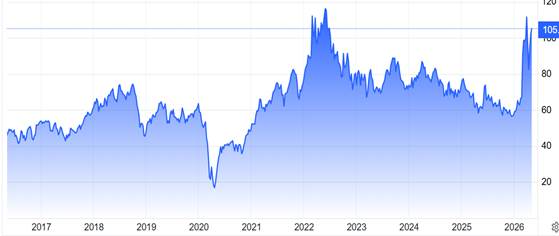
War in the Middle East disrupted oil supplies and resulted in a sharp spike in the oil price in early 2026. It is reasonable to now expect the combination of lower production costs with higher sale prices to result in hugely increased profitability for these two businesses – it remains to be seen for how long.
Can they take durable advantage of this abnormally large profitability gap that currently exists? Should they?
For the leadership of Exxon Mobil and TotalEnergies it could reduce to a simple equation. They know they can produce oil at a low cost. They know what their expected volumes of production are for many years ahead. They know they have the scale and skills to manage production risk and build in significant margins of safety in their cost and production assumptions. Using the financial markets, they also have the ability, should they wish, to lock in today’s high oil prices and their own abnormally high levels of profitability, and thereby increase and maximize long-term business value.
I always hoped to find a listed cyclical commodity business with the understanding, ability, courage, and ownership support to responsibly hedge at or near the top of its commodity price cycle. I must add, this only applies to commodities such as oil with deep coverage and liquidity in the financial markets. One possible reason for my inability to find one is the inherent principal-agent conflict that exists between long-term oriented business owners and short-term oriented share traders and any executives who pretend to be principals but who act as agents.
These agents often appoint and hide behind hired external advisors, who themselves are agents. When it suits their agenda these advisors present ‘independent corporate finance studies’ showing that unhedged cyclical businesses tend to outperform hedged ones over full commodity cycles. Their ‘scare story’ is what happened in the early 2000’s when large gold mining companies had hedged themselves – but the truth is that those large gold mining companies had hedged themselves at the bottom of the gold price cycle. Those same gold mining companies who had hedged themselves when gold was at $200 are now unhedged with gold hitting $5,400 recently.
From the perspective of the CEO’s of Exxon Mobil and TotalEnergies, the strategic decision to lock in these abnormally high oil prices and profitability right now – as much as that might be the right thing to do for long-term owners and stakeholders - can easily cost them their jobs in the event the oil price goes even higher in the short-term. This is the sort of situation where the composition and conduct of the Board of Directors, and who and what they choose to be influenced by, plays a massive role.
My realistic expectation is that while they probably should hedge, and they definitely can hedge, they probably won’t hedge.
Our work continues…