
Investing vs. Trading
Daniel Malan, CFA Founder, Managing Director & Chief Investment Officer, Perspective Investment Management
One of the great ironies in the investment industry is that many market participants learn and talk about long-term investing principles but practice something entirely different – namely short-term trading.
Entry-level undergraduate finance textbooks cover one of the rudimentals of finance – the so-named Discounted Cash Flow. It rests on an essential concept – The current value of any asset equals the sum of the present value of all of its future free cash flows. This valuation method is routinely used even in extremely large control transactions between astute corporate counterparties.
In practice the masterful long-term investors, be they entrepreneurial families, businesses, or professionals, have all followed a seemingly simple approach – (1) wait as long as it takes to (2) buy good businesses with good people at good prices and (3) hold onto them for as long as possible, and preferably forever. Insofar as their transactions go, they view the stock market as a tool that provides liquidity for them to occasionally access. Their research focus as long-term intentioned owners is on what their businesses are worth and the key factors that influence said worth over the long run. They buy to own. They get excited by the act of ownership. This is investing.
What I find so fascinating is that despite the ready availability of all of this immense body of knowledge that exists in both theory and evidenced practice, the truth is that many market participants talk a great story but act very differently. Based on their activities, it appears their focus is purely on buying and selling over short periods of time, sometimes measured in minutes. Their frenetic activity to execute transactions defines them. Their research focus is on where stock prices can go to over short-term periods. They buy to sell. They get excited by the act of transacting. If it looks, swims, and quacks like a duck, it is probably a duck - This is trading.
To me, investing is about allocating long-term savings capital to the best long-term business investment opportunities our team can identify anywhere in the world. We respect and need the stock markets, because it provides us with liquidity to not only build our positions with but also to address our mistakes when we may need to, but it exists as a tool only – it is not the source of our inspiration or returns. Owning good businesses with good people for 5 to 10 years and preferably far longer is our source of inspiration and returns.
Chart 1: Franklin Templeton & T Rowe Price vs. Interactive Brokers
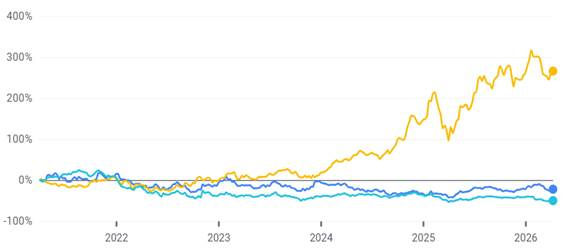
No prizes for guessing the clear ‘winner’ from a 5-year share price perspective in chart 1 is Interactive Brokers, with a business model highly geared to market participants’ short-term trading activities. In contrast, the two ‘losers’ are large-scale global investment firms with business models highly geared to common sense long-term investing principles.
These performance divergences between the business models of investing and trading move in cycles, and I sense we may be near an inflection point.
Our work continues…