National Financial Ombud strengthens trust with sweeping consumer wins

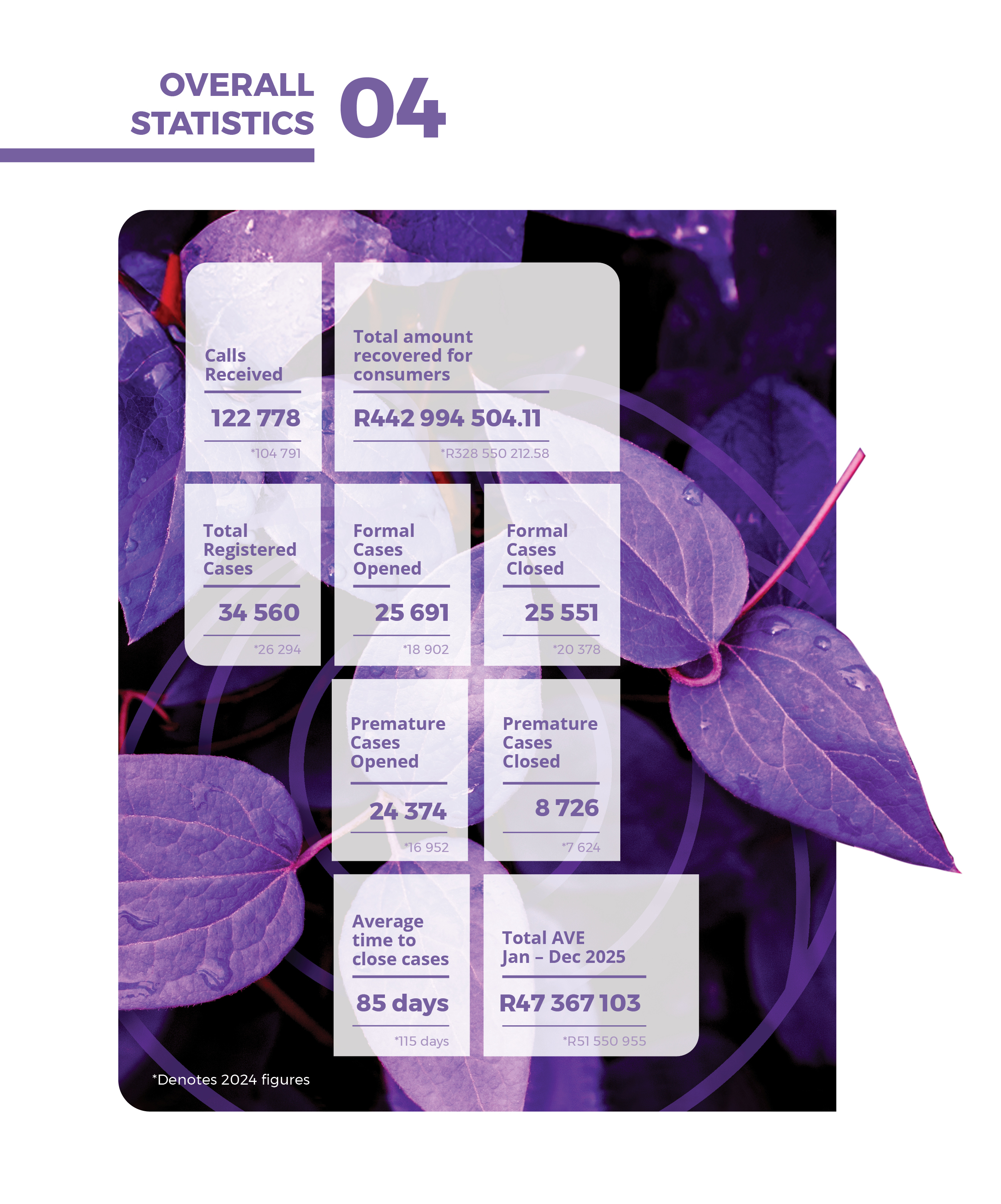
All three divisions of the National Financial Ombud Scheme (NFO) played a role in securing the R442.9 million returned to complainants. Their contributions varied in scale - not because of effort, but because each division oversees different categories of financial products, and the scope of those products determines the size of recoveries.
The Banking and Credit Division recovered R60 475 870.59 (R53,002,204.18 and R7 473 666.41); Life Insurance R299 629 812.82; and Non-life Insurance R82 888 820.70.
Life Division: Funeral Benefits Still A Bane
Life Lead Ombud Denise Gabriels said both premature and formal cases increased steadily. Premature cases rose from 321.0 per month in 2024 to 421.17 in 2025 (about 31.2% growth), while formal cases increased from 350.4 to 447.58 per month, representing an increase of approximately 27.7%. This indicates a consistent upward trend in complaints progressing through the system in the life insurance sector.
Funeral benefits remained the most complained-about product, making up 46.2% of cases, followed by life (33.9%) and disability (7.4%). Gabriels said declined claims were the biggest driver, especially funeral benefit complaints and disability disputes. The division issued four final rulings against insurers during the year.
Digital Banking Fraud Complaints Surge As Scammers Evolve Tactics
Fraud remained the highest category of complaints in the banking division. As more consumers turn to digital banking, fraudsters are increasingly exploiting online platforms, warned Banking and Credit Division Lead Ombud Nerosha Maseti.
Complaints involving unauthorised transactions, account hijackings, and social engineering scams have risen sharply. While scammers continuously adapt their tactics, their aim remains unchanged: convincing bank customers to disclose sensitive information or approve fraudulent payments.
The banking industry has strengthened fraud prevention strategies by investing heavily in advanced security technologies, including artificial intelligence that can detect and flag suspicious transactions. In addition, they are intensifying customer awareness campaigns to educate consumers about the prevalent scams.
Over R53 million was awarded to banking customers who lodged formal complaints. Approximately 60% of this amount was attributed to refunds and awards in fraud-related cases. In most cases where monetary awards were made, the findings revealed that banks had failed to act quickly enough on becoming aware of fraudulent activity, highlighting the importance of timely intervention.
Of the 14 685 cases registered by the Banking Division, the majority of complaints related to the country’s major retail banks. A smaller number of complaints were recorded against other banks. Standard Bank led with 2 975 (20.2%), followed by FNB (2 705), Capitec (2 641), Nedbank (2 482), and Absa (2 234). Premature banking cases rose 11% year-on-year, while formal cases jumped 25.4%, cementing banking as the largest driver of case volumes.
Credit Grows Consumer Confidence
In July 2025, the Banking Division merged with Credit to form the Banking and Credit Division. “The strategic move to bring the two divisions together has allowed for greater operational efficiency, improved knowledge-sharing, and a more holistic approach to resolving financial disputes,” Maseti said.
During the year, the Credit Division registered 3126 complaints, up from 1979 in 2024 – an increase of 58%. During this period, 62% of complaints were resolved in favour of consumers. Credit showed the sharpest spike: premature cases more than doubled, while formal cases climbed 12%.
Total amounts recovered by the Credit Division increased from R2.36 million in 2024 to R7.47 million in 2025 - more than triple. Credit complaints also flagged poor affordability checks, credit refusals, and unfair debt collection.
Beyond traditional credit disputes, 2025 saw a noticeable increase in fraud-related complaints, particularly involving card-not-present transactions linked to vishing scams and the unauthorised use of card details and one-time passwords.
Maseti said the role of the Credit Division is evolving - moving from primarily
handling contract disputes to increasingly protecting consumers from the very real and growing impact of financial crime.
Non-life Insurance: Cars and Homes Complaints Dominate
In the Non-life Insurance Division, motor vehicle insurance accounted for 35% of complaints, followed by homeowners’ insurance at 27%.
Lead Ombud Edite Teixeira-McKinon noted that accident claims made up 70% of vehicle disputes, while theft and hijack claims were 8%. The primary reason for complaints under this category of insurance was claims rejected on the exclusion of driving under the influence, followed by lack of due care, also referred to as recklessness.
Under homeowners’ insurance, acts of nature (42%) led the complaints, followed by burst water apparatus, such as geysers (15%). The biggest flashpoint: rejected claims on the basis of exclusions for gradual deterioration, lack of maintenance, or wear and tear, followed by defective design, construction or materials.
The Non-life Insurance Division ended the year with 2% less registered complaints and 3% more resolved complaints when compared to 2024; 10 054 registered complaints and 11 428 resolved complaints.
The average turnaround time (TAT) to resolve complaints was 105 working days; the TAT decreased from 117 days at the beginning of the year.
“The significant reduction in the TAT can be attributed to the increase in staff capacity at the beginning of the year and the decrease in new registered
complaints in the second half of the year, both facilitating an improvement in complaint handling efficiencies in the division,” said Teixeira-McKinon, adding she was thankful to the staff of the division for the “passion and dedication with which they approach each working day”.
Building the Ombud’s Voice
Beyond casework, the NFO’s Marketing, Communications, and PR team, led by Priya Rajah, pushed the brand into a new era of increased visibility and sustained public trust.
Digital campaigns soared:
- Facebook reached 1.25 million impressions
- LinkedIn engaged 782,000 users
- X (Twitter) posts hit 5.5 million impressions
The team’s efforts focused on promoting financial literacy whilst ensuring the NFO’s voice is recognised as credible and authoritative within South Africa’s financial ecosystem. Rajah emphasised the importance of media engagement across print, broadcast, and online, especially in underserved and rural communities.
“Coverage extended into underserved and rural communities, reflecting a deliberate strategy to increase inclusion and accessibility,” she said.